Sunday, February 15, 2009

The Very Best Kind of 'Multi-Tasking'

And I thought everyone always did it this way!


At least in the meet-and-get-to-know-you phase!

Tuesday, February 10, 2009

Lady Ottoline Morrell (1873-1938) - Sociability in 'A Spanish Galleon Hung with Golden Coins and Lovely Silk Sails' (Virginia Woolf)

Lady Ottoline Morrell (1903)

When I was living in London as a kid, I met someone who totally - but totally - changed my ideas and approach to sociability.

Eve Disher (1894-1991) was then well int0 her eighties and had been a minor painter of the Bloomsbury Group. She seemed to follow E M Forster's dictum of 'only connect' - garnering friendships with such disparates as Noel Coward, Ian Fleming, Kenneth Clark and Sir Arthur Elton, Bart., one of the pioneers of documentary film in Britain in the thirties.

Eve Disher as I Knew Her - We're Just About to Head Out for Dins

We first met through Julia Elton in Eve's large Eccleston Square flat, which was wall-papered with the history of avante garde British painting of the first half of the C20. But instead of talking about herself, she sat me down and said 'Hello Nick, I'm Eve. Lovely to meet you! Tell me all about yourself'. Which was not a conceit or a segue just to talk about her own big connected life and work. I was shy but quite uncharacteristically drawn out - by her intense warmth and empathy ... and have always been immeasurably grateful for being shown another way of being with people.

Now, I suspect Eve may have developed this seductive sociability either meeting, or hearing and reading about, Lady Ottoline Morrell - arch patroness and hostess for the Bloomsbury Group of Virginia and Leonard Woolf, Lytton Strachey, Vanessa and Clive Bell, E M Forster, Roger Fry, John Maynard Keynes, Vita Sackville-West, Bertrand Russell (Ottoline's lover for many years), D H Lawrence ... . There are debates about who were central to the group and who more peripheral.

Ottoline gave a context for the group at her 'Thursdays' at 44 Bedford Square, Bloomsbury ...

Ottoline First Home in London - 44 Bedford Square, Bloomsbury

... and at her country home, Garsington Manor ...

Ottoline's Country Home - Garsington Manor

A 'Greek' Moment in the Garden of Garsington Manor

Picnic with Dorothy Brett, Lytton Strachey and Bertrand Russell (Ottoline's lover of a number of years)

She slips through the pages of current British histories of the arts and letters, more as a footnote than a fully realized participant.

And this belies the importance of this extraordinary 'apparition' of the first decades of the C20 - variously described as 'a Spanish Galleon hung with golden coins and lovely silken sails' (Virginia Woolf), 'an over-sized Infanta of Spain' (Osbert Sitwell), 'a queen among women' (D H Lawrence), 'that fantastic baroque flamingo' (Vanessa Bell, Virginia Woolf's sister) ... it goes on and on.

Ottoline in Particularly Baroque Mode (1912)

With her appearance alone, Ottoline would stop people in the street - provoking stares, laughter, even jeering - perhaps in Turkish attire, or pale purple hair when this was unknown, or .... . Even her voice was extraordinary - the writer Stephen Spender recalled how she 'emphasized syllables ... [in] horn-like blasts'.

Her florid and exaggerated hand-writing is a cypher for the over-blown persona.

Ottoline's Hand-Writing

Born into the aristocracy as the half sister to the 6th Duke of Portland and as a cousin to Elizabeth Bowes-Lyon (later Queen Elizabeth, the Queen Mother), Ottoline as a young woman broke with her class - studying at Somerville College at Oxforn University, and mixing in the bohemian artistic world, often an 'aristocracy' unto itself.

However, she was not always accepted into the new milieu in the way she wished. This was perhaps best exemplified in D H Lawrence's savage portrayal of her as Hermione Roddick in 'Women in Love' (1916) - someone 'only wanting to know' but, in this, sucking the life blood out of the thing.

Above and beyond all this, and in fact her true legacy, was Ottoline's rare gift of being able to stimulate and excite intimacy. Even those who made the greatest fun of her (such as Virginia Woolf) would be drawn back in again - with renewed contact and conversation.

And it is this characteristic Eve Disher - and so many others - took into her life and which made her special in turn.

And I'm more than grateful to have had an ever-so-tenuous connection - cos it has been one of the greatest influences on my own life.

Ottoline Morrell in old age

I think the best introduction is the biography - 'Ottoline - The Life of Lady OttolineMorrell' by Sandra Jobson Darroch (Coward, McCann and Geoghegan, New York 1975).

Enjoy, if you dare!

Monday, February 9, 2009

Ethnicity in 'Life' Magazine in the C19 - Wallace G Levison and Others

Native American Kiowa boy, Lone Bear (Tarlow) lying on animal skin rug, dressed as Osage [?] (1870)

In the archive, I found only a handful of non-Caucasian images - sign of the times of course.

Of African Americans, there are mainly images of manual work, or blacks embedded in a wider white community in some form or other, such as in the following ...

A young black boy pulling reins of a horse drawn coach, owned by Surf Ave Stage Co, alongside the boardwalk at Coney Island (1884)


Civil War Portrait of Taylor, a black drummer boy, 78th Regiment, US Colored Infantry, during Civil War (1861)

First African American to actually serve in Congress Hiram R. Revels (1870)

There are a very few exceptions, such that of a woman, presumably at home, putting out her washing.

A colored woman hanging laundry in the backyard of farm-like home (1889)

For me, this image is one of the most effecting in the collection - as it just presents the woman in her real everyday life at home and within her own culture.

Native Americans are mainly approached in the ethnographic mode of the period ...

Native American Indian family from Southeastern ID reservation, wearing tribal vestments (1897)

Native American Indian from Southeastern ID reservation, standing on handcrafted rug and wearing tribal vestments (1897)

Native American Indian from Southeastern ID reservation, wearing tribal vestments (1897)

Native American silversmith from Navajo tribe sitting with his wares (1870)

... with only occasional hints at anything other ...

Asa-to-yet, Native American Comanche chief, sitting w. arms crossed & gun in hand (1870) Photographer: Will Soule

Paiute Indian chief Tau Gu standing with American explorer geologist Major John Wesley Powell near Rio Virgin River (1873)

Too soon for this reprise post ... but I couldn't stop myself!

I was in fact spurred on by recalling something from the film 'The History Boys'.

It was the observation by the older gay teacher that it was only in the late C19 that the names of ordinary soldiers were publicly recorded to be remembered.

So, in the context of this archive, I was more than a bit surprised to see the name of the black drummer boy recorded ('Taylor') as early as 1861.

Sunday, February 8, 2009

Children at Play in the 1880's - Wallace G Levison for 'Life' Magazine

Wallace G. Levison sitting on a pedestal on Statue Of Liberty island looking out at boats in NY Harbor (1885)

Today, I came across Google's 'Life' Magazine Photo Archive for the second half of the C19 and much of the C20.

Perhaps most interesting for me were those of the 1880s - mostly by Wallace G Levison. I googled this photographer and surprisingly nothing came up, bio-wise. You know anything?

Levison produced much work for the magazine within a great ranges of contexts - the sea-side, cityscapes, modes of transportation, dress of the day, dining at home, work ... and children at play:

Children holding hands in a circle as they dance around a pole with their backs to it (1886)

Young Ethel Merritt jumping in the air at Coney Island (1886)

Young Isabel Harter riding a tricycle while her sister Nellie rolls a hoop, with other children and adults in background (1886)

Zelma Levison jumping in the backyard of her home at 314 Livingston St. (1886)

Young girls Isabel and Nellie Harter jumping a rope turned by Edie Dwight and Zelma Levison. Nellie Dwight on the bench and Edie Swan on the cannon wait their turns. Ft Green (1886)

Edie Swan and Harry Dwight rolling hoops in a field as other children look on in background. Ft Greene (1886)

Four young girls jumping off a waist-high wall as two women look on at Ft. Greene (1886)

What's so appealing about these photos is their seeming spontaneity and the way they catch some of the innocent pleasures of childhood.

Which is seems at odds with the current politically-correct view of that period of our lives as being trauma- and angst-ridden.

Wednesday, February 4, 2009

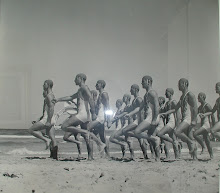
Guido Daniele (1950-) and Extraordinary Hand Paintings


Born in Italy and now living in Milan, Guido Daniele works in the visual arts and advertising in a number of capacities: as an illustrator, theatre scene painter, make-up artist .... and body painter.

His hand paintings are particularly arresting!


Amazing aren't they?

Sometimes you miss the hand altogether!

His website is - http://www.guidodaniele.com.

Tuesday, February 3, 2009

Long Dead Relatives Popping Up Everywhere!

Now I'm sure you'll be thinking I'm just making this all up ... but some mid-C19 relatives might have made an appearance in my study this afternoon!

Actually should I be saying 'yet more' cos, as you may remember, I posted last month on a recently uncovered photograph sent me of two new mid C19 relations:


This is it - today, just before lunch, I was 'dismembering' these two framed colour-tinted etchings to be better able to scan them into the puter.


A kind of current mania with me!


And discovered that their glass backings were in fact silver gelatin on glass photographs!!!

One in quite good condition ...


... and showing (it seemed) a resemblance to my great grandmother (her own mother?) ...


... and the other rather too damaged to make much out ...


My paternal grandmother grew up way out in the bush, well away from towns of any kind. She told me how hawkers would drive round the countryside in horse-drawn 'vans' which functioned as shops selling 'darning wool or strong black cotton ... or new stockings'. She recalled one hawker called Bob, who used to periodically visit the farm 'to stay the night ... do his washing, give his horses a spell and tidy up his shop' (from a story she wrote about a family pet, a Shetland pony).

Last century in the bush, home decorations and ornaments were often home-made.

As a consequence and throughout her life, my grandmother created little framed pictures using images from newspapers, magazines and so on. So I always imagined she or one of her sisters had made these two beautiful little objects - perhaps as girls. And would have used whatever was available for their backing. Though it's hard to imagine she'd have used old family photographs - but equally odd that she'd have had another family's photos to use.

Mmm.

There IS one more piece to this puzzle!

I've just phoned my sister, having earlier emailed her these two images. And she said she had copies of them! In a tiny leather bound book encased in a small leather box. Really!!!

She'd been given them a year or two ago on the death of the executor of my mother's estate - apparently he'd been entrusted to their safe-keeping for some reason.

Such care-taking would suggest (to me) more than just a treasured object. Something of irreplaceable family significance.

Or is does this all have some other explanation? And these are no relations what-so-ever?

I'm waiting for the next chapter to unfold!

And at this rate, it should only be a few weeks!

Monday, February 2, 2009

Norman Gentle - Funniest 'American Idol' Audition ... Ever?


Just watch!

And if you've seen it before, enjoy again!


And?
Scrotums as Pets? No, Just Naked East African Mole Rats


No this is not the product of some rather creative Hollywood workshop - though it's probably been the inspiration for more than a few film fantasy monsters:

And I haven't been doing funny things with my scrotum just to amuse everyone, though ... I won't go there!

Or browsing installations at more avant garde art galleries ...


Just watching a David Attenborough documentary on mole rats, a kind of hairless East African burrowing rat that lives mainly underground and tunnels huge and complex networks in search of the tubers on which it subsists.


They live up to 28 years of age which, apart from being a good advertisement for tubers, has lead to investigation of its genome.

Their social structure is a bit like that of ants and bees, where there's a single breeding female and two or three consorts in each borrow complex - with the rest of the colony being tuber hunter-gatherer workers.


Only a mother could ... you know the rest!

Now if you wanna see a living example, up close and personal ... best thing to do is drop your jocks and take a good long look between your legs - LOL!!!