Friday, September 19, 2008

Me and Orangutans - A Long-Term Love Affaire


My love affaire with the 'person (orang) of the forest (hutan)' began when I was living in London. I used to go to the zoo to see 'George' - we seemed to connect at times, our eyes fixing through the bars of his cage. Often for quite long periods. So gentle, calm, sweet, focussed. Hopefully, there's not too much anthropomorphism here!

And the affaire has never diminished. And was given a huge boost last year with an up-close-and-personal episode in Vigan, the Philippines. There was lots of hand holding, general touching, nose stroking, and head patting. Mostly both ways, with much eye-to-eye work! So lucky - usually zoos won't allow you to get so close!


Orangutans are now only found in Borneo and Sumatra - with only 20, 000 left in the wild. So when I saw the clip 'Nyaru Menteng - A Glimmer of Hope' encouraging people to help save these extraordinary creatures (www.orangutans.com.au), I couldn't resist a post. These snags from the documentary are followed by the footage itself.

So the babies ...


... and some juveniles ...


.. and all put together:

Sunday, September 14, 2008

Frederick Ashton (1904-1988)


When I was a kid living in London, I remember seeing Frederick Ashton as one of the Ugly Sisters in the Royal Ballet's 'Cinderella'.

I recall two things vividly.

The first was the psychologically complex characterization: the warm, teasing, self-centred, loving, vain, vulnerable, shy, sly, nervous ... monster! In comparison with Robert Helpmann's much more broad-brush-stroke panto creation - as the other sibling. Some of all this is captured in the following photos:


The second occurred at the Ball. Each sister was vie-ing for the tall handsome prince as partner, as opposed to the other short ordinary-looking one. Of course Helpmann's tough and go-getting sister wins out. But then cunningly and placatingly whispers something in her gentler sister's ear - drawing a surreptitious but long glance at the diminutive prince's crotch. With a slow lascivious smile spreading over her face!


After the performance, I was introduced to Ashton and asked him to sign a book I'd just been given about his choreography.


I'm sure he sensed I was gay. And without being able to think just what to say to a young fag, gently declared that it was raining outside and my book would need a mackintosh (raincoat) to get it home safely.

Tuesday, September 9, 2008

Art Deco Chinese Advertising Posters

'Fun at the Pool' - Shanghai, 1930s

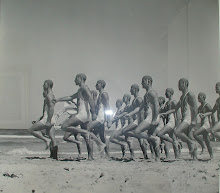
I don't want to say more than a couple of things about these amazing Chinese art deco advertising posters, mostly from the Shanghai of the 1930's. Introduced to me by a French friend temporarily living in Australia about 10 years ago.

Without judgment, they represent the new somewhat internationalized images of Shanghai China of the period - realizing the prevalent desire for modernity. From smoking ...

RenDan Drink - Shanghai, 1930s

... to using a telephone ...

Creme of Lait French Face Cream - Shanghai, 1930s

... and the art deco stylistic influence.

Something of course not restricted to the Middle Kingdom. And something not necessarily wide-spread within the then Republic of China. These posters were for local consumption - being 95% in characters, and 5% in Roman script (usually the name of the product) to give that sense of modernity.

Embassy Virginia Cigarettes - Shanghai, 1930s

What would be interesting to know is which were commissioned by European companies with interests in the concessions of the city, and which by local firms. As the degree of internationalization varies:

BeiPing Five Star Beer - Shanghai, 1930s


Chiyo-Yoko Photo Supplies - Shanghai, 1930s


Manchurian Thousand Happiness Liquor Factory, Japanese Sake

Kwong Sang Hong Company - Based in Hong Kong, 1928

Ai Er Camel Fabrics - Shanghai, 1930s


Twin Beauty brand cosmetics - Shanghai, 1930s


Shanghai Cigarettes - Shanghai, 1930s

Leopard Eng Aun Tong Pharmacy company - Shanghai, 1930s


Sa Bei Cigarettes - Shanghai, 1930s

You are all on notice - I will kill anyone who attempts to comment correct things 'lost in translation'!

No, I see you! Keep AWAY from that keyboard! (Jon!)

Sunday, September 7, 2008

Leni Riefenstal (1902-2003) - Aesthetics and Politics - and Constructing Identity


Like the architect Albert Spier, the film-maker Leni Riefenstal imagined she could engage in art without reference to politics. Both worked within the German Third Reich and one could argue further compromised appreciation of their work in friendships with Adolph Hitler and Joseph Goebbels.

First I looked at her 'Olympia', an official record of the Berlin Games of 1936, with its extraordinarily innovative filming techniques ...


... and then I browsed some of the film's promotional stills, images that hark back to our imaginings of the first Olympics.


I could enjoy her use of slow motion to fully appreciate rapid action. And close-up to see detail of physical effort and athletes' emotion. New angles on action, such as the in-the-action view from trenches the film-maker had dug beside track and field events. And the close upshot for the diving:


But it was difficult to disassociate Riefenstal from the Nazi Regime, particularly in her earlier films, with titles such as 'Triumph of the Will' and its resonances with national socialist philosophy.

So I turned to the book of her (later) photographs of the Nuba tribe in Sudan (1975).

These are images which Susan Sontag has claimed still smack of 'fascist aesthetics'.


And I was about to proceed along this line but then I realized there was a more interesting approach to Riefenstal's work: considering how Africans viewed her vision of the Sudan. So I searched around and found the anthology 'Beautiful Ugly: African and Diaspora Aesthetics' by African artists and scholars in the 'Thought Leader - Mail and Guardian Online'.

In his review of the book and with particular reference to a chapter on Riefenstal's photo essay of the Nuba, Yazeed Zamaldien considers the issues of the 'oppressive misrepresentation [of Africans] during the colonial period and its redefinition during post-colonial restructuring'. In particular, the conceptualizing of beauty and uglyness.

With respect to the colonial period, Zamaldien identifies the outsider mechanisms of exoticisation and grotesquing. Riefenstal's images now begin to take on another hue.


With respect to redefining notions of beauty and ugliness in post-colonial restructuring, Zamaldien speaks of attending a festival in the Nuba Mountains last year and being confronted by an other-than-colonial construction of its people. He continued, to say:

Eight Nuba tribes had gathered for the three-day festival and among them were Muslim, Christian and animist believers practising their collective cultural heritage alongside each other. It raised again the question of perceptions of Africa: who sees what and how.

The book does not seem to be providing solutions as much as raising the interesting and core issues to be addressed.

And to all these issues is added the complication of the internationalization of beauty and ugliness and identity, through, among other sources, the juggernaut of the fashion industry.

Here in Australia we have a related (pseudo?) problem - of imagining we have to develop a national identity. Such an identity would need to take account of all the feeds from indigenous Australia and Britain, and all the countries from which newer migrants originated.

But such identities tend to work against diversity. Diversity like being in the gay community. So difference within unity. A tough (but necessary) one!

Thursday, September 4, 2008

The Photos I Didn't But Could've Taken of Paris


I traveled in Europe for four months in 2003, and rented an apartment in Paris for six weeks. But for various reasons took very few photographs of my all-time favorite city that trip.

Then yesterday, deep in cyber space, I saw the photographs I would've taken! Or did I actually take them and then I simply forget?!

But while I imagine they could/might be mine, they are 'foreign' too, more and less.


Seeing these photos has let me think about how I like my own to be.

More 'centred'. And in balance, according of course to my own eye. The central focus to be more obviously arresting. I want to be closer to whatever I am concentrating on. With more calculated framing. And the cut-off bits more obviously and consciously decided. Other choices of detail.


I've learned some new ways of approaching outdoor scenes. This next shot has a nice closed-in feeling - you have a sense of being cramped in between the walls and the cars, as you can do walking round medieval streets. I would've wanted it to be more opened out.


I'm really surprised how specific I've found my 'eye' to be, looking at someone else's snaps.

Or ... is this all just an opportunity to do some big nostalgia! And finally a chance to do my comprehensive if belated Paris post.